

|
 |



IR X-Ray Vision can be used for improving visibility through certain kinds of fog or haze. This property is particularly important for long-distance photography on the ground where the detail of distant objects is often obscured by fog, mist, haze, rain, snow, smog, dust or sand. It is also useful for high altitude, and especially oblique photography from the air like when landing an airplane in a foggy airport. Actually, IR X-Ray Vision does not always result in a very striking increase in the range of vision, but it generally increases the contrast of the distant objects and thus the amount of detail that can be seen.
Police Force
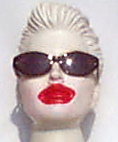
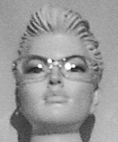
IR X-Ray Vision can help you to see perfectly through sunglasses and dark, tinted car windows. Let's imagine there's a man walking the street. He fits the description of a known murder suspect, but he is wearing a pair of dark sunglasses, so no-one can see his eyes. Yet there is a way to check his identity without even having to approach the man - a camera equipped with a KAYA PF filter would see straight through the dark sunglasses. To the viewer, they now appear totally transparent, like standard glasses. The man's face would be identifiable even if he was in a car with tinted windows!
Voyeurism (not encouraged!)
IR X-Ray Vision is able to see through some types of clothes, for example, thin clothes, tight clothes, sundresses, swimsuits and so forth. Be aware that this means that you can see a person's body or underwear through the external garment. In other words, a camera equipped with the PF filter allows you to "see through" someone's clothes. It is also possible to see through a woman's made-up face as if no lipstick and foundation had been applied.


Pollution Monitoring
IR X-Ray Vision can be used in pollution monitoring applications. Since both water and air when pure have very low NIR (Near Infrared Rays) reflectance those appear very dark when viewed through a camera equipped with the PF filter. But their reflectance may be greatly increased by the presence of minute quantities of dissolved or suspended materials and this makes them appear less dark under the same conditions. Though IR X-Ray Vision will not detect thermal pollution such as warm water entering a river from a generating station or hot gases above a smokestack, it may detect chemicals, certain dusts, pollens, aerosols and gases dissolved in gaseous or aqueous effluents owing to pure water and air's low NIR reflectance.
Ice Reconnaissance
IR X-Ray Vision can be used to obtain data on sea-ice distribution and movement. Because of its low reflectance to infrared radiation, water appears very dark and the ice appears light in an image. Therefore, the interface between water and ice and land becomes highly discernible.
Agriculture, Plant Pathology and Forest Survey
IR X-Ray Vision can be used in agriculture, plant pathology and forest surveys for the detection of crop yields, crop and tree diseases, insect infestations in forests and orchards, and identification of tree species. NIR images of foliage made with a camera equipped with the PF filter often show great variations in NIR reflectance even when leaves visually show just small variations in shades of green. When viewed through a camera equipped with the PF filter, healthy grasses and the foliage of healthy deciduous trees appear white because of the high NIR transmission characteristic of green chlorophyll and the high NIR reflectance of the underlying cellular structure of these subjects. On the contrary, diseased and dead trees and burned grass tend to appear dark in an NIR images. Also in any given vegetation, the season, the water and mineral content of the soil, and the age and health of the vegetation may cause its NIR reflectance to vary. In fact, the first sign of a distressed tree (or plant) is often a decrease in NIR reflectance, which frequently first becomes apparent in NIR images. This means that the first sign can be detected by using IR X-Ray Vision before trouble becomes apparent visually.
Documents and Paintings Inspection
Inks, dyes, pigments, and other materials which may appear indistinguishable to the eye often appear differently in NIR images. Printed matter, engravings and photographs that have become undecipherable through dirt or age or other damage can frequently be revealed when viewed through a camera equipped with the PF filter. Mechanical or chemical erasure can often be determined, even if overwritten, provided the overwriting is in an ink transparent to NIR. Even writing on documents charred in fires can also be readable provided the charring has not gone too far. Differences in inks and dyes used in forged documents, certificates or identification can also be distinguished when viewed through a camera equipped with the PF filter. IR X-Ray Vision often penetrates the surface of ancient inks and dyes of paintings, art or artifacts and reveal what lies beneath. Thus, paintings or other similar works of art can be examined to determine the authenticity of those or to see if there has been over-painting or other alterations.
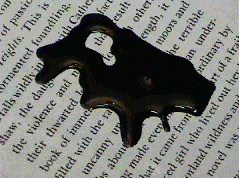
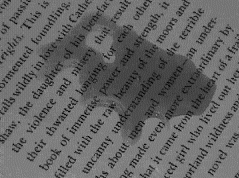
Particularly, fluoresced see-through techniques often show off its surprising ability to make visible a subject that gives our eyes very little or no clue as to its existence. Here is one example: The subject was a letter that had been placed in a home-made time capsule and buried near the cornerstone of a private home. 20 years later it was unearthed and, to the dismay of the family, all the words written by the mother of the family with pen and ink were washed away by water that had seeped into the box. The residual ink remaining in the paper was quite invisible to the naked eye but our fluoresced see-through technique reveals the messages dramatically.
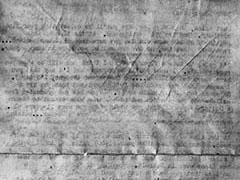
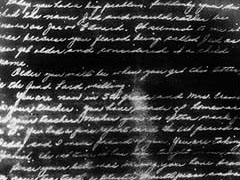
Thus, IR X-Ray Vision can be a simple yet powerful tool for the study of faded, burned, worn, dirty or altered documents or paintings, secret writing and so forth.
Camouflage Detection
IR X-Ray Vision can be effective for detecting camouflage when photographing objects painted to simulate foliage. Camouflage detection may be possible by directly comparing a normal picture with a NIR picture of the same objects. For example, most normal green paints, which match green foliage visually, are strong absorbers of NIR and appear dark in a NIR picture, while natural healthy green foliage appears white. So camouflaged areas are most easily detected through a PF-equipped camera's viewfinder or LCD screen.
Textile Industry
IR X-Ray Vision can be used in the textile field for detection of irregularities to the fibers, particularly where the material is dyed a dark tone and visual examination is difficult.
Some other applications where IR X-Ray Vision can be used include: environmental studies, natural resource studies, monitoring geographical and geological changes, investigating coastal erosion and identifying marsh land vegetation, archaeological exploration, surface mining and mined land disturbances, hydrological studies and channel mapping, monitoring oil spills, irrigation studies, medicine, mineralogy, philately, art history, entomology, etc.
Thus, the imaginative user should have little difficulty in recognizing the potential of IR X-Ray Vision and expanding its use.